

Written & reviewed by Nguyễn Hồng Ân- Head of R&D, Vida Farm
Nguyễn Hồng Ân leads R&D and quality control for Vida Farm’s ube powder and purple sweet potato powder products, with expertise in raw material evaluation, processing, and product quality.
If you’re sourcing natural purple food ingredients, you’ve likely come across two products that look almost identical in photos: ube powder and purple sweet potato powder. Many food and beverage brands assume they’re the same thing with two different names — and that assumption can lead to the wrong ingredient ending up in a product formulation. This guide breaks down exactly how they differ, so you can choose the right one for your recipe and your supply chain.
1. Different Raw Materials, Different Botanical Origins What Is Ube Powder?
Ube powder is made from Dioscorea alata, commonly known as purple yam. It’s a tuber crop widely grown across the Philippines and Southeast Asia, prized for its naturally sweet flavor and deep purple flesh.
What Is Purple Sweet Potato Powder?
Purple sweet potato powder comes from Ipomoea batatas — a completely different plant family from ube. While both are root vegetables with purple flesh, they belong to entirely different botanical genera, with different growing conditions, flavor compounds, and pigment structures.
The bottom line: these are two distinct crops, not two names for the same ingredient. Some suppliers market purple sweet potato powder as “ube powder” simply because of the similar color — something buyers should watch for when sourcing.
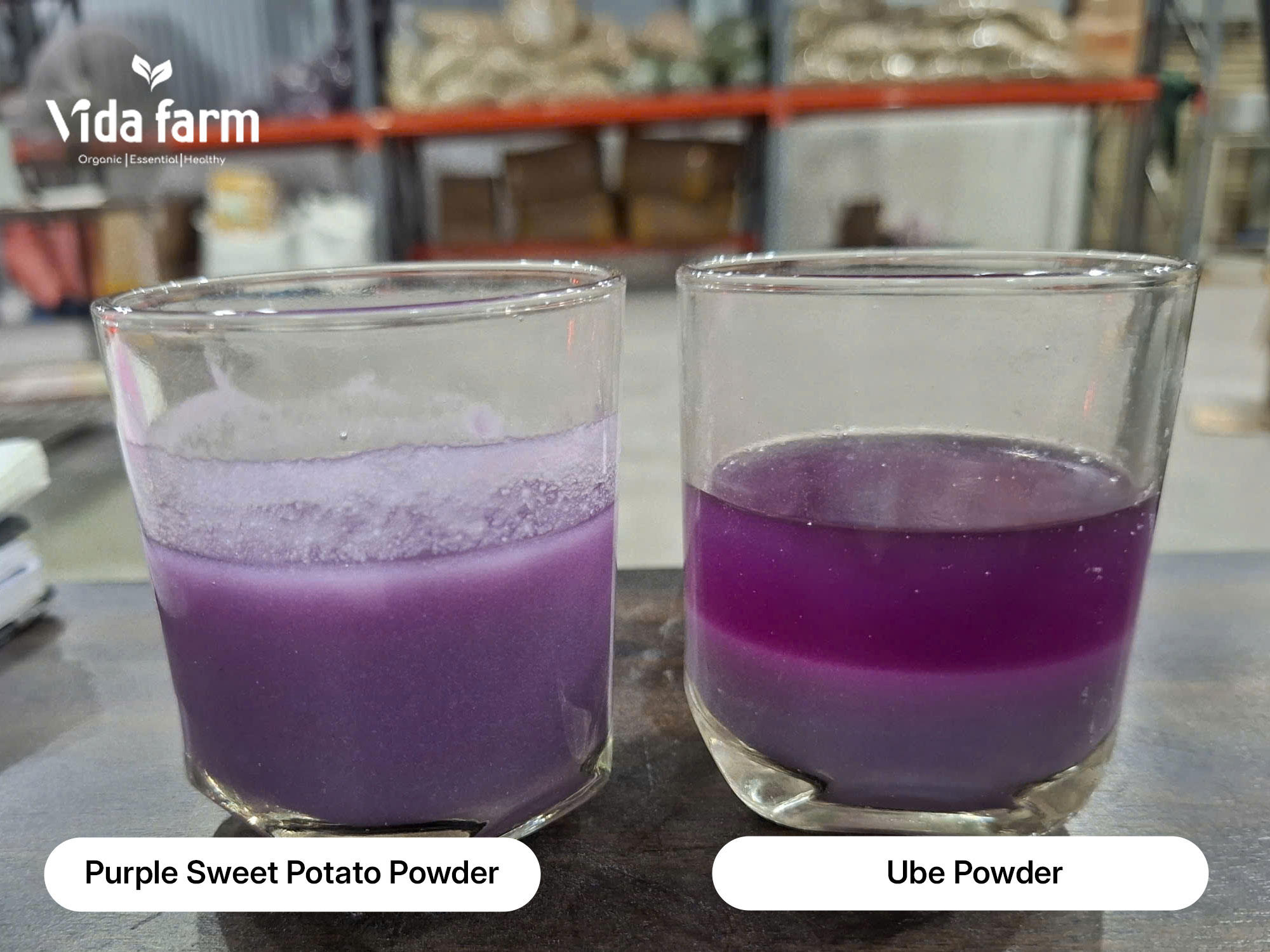
2. Color Comparison: Which One Is More Vibrant?
Both powders deliver a natural purple hue without artificial coloring, but the shade differs noticeably.
“Ube powder has a bright pinkish-purple color, while purple sweet potato powder is a deeper, richer purple,” says Nguyễn Hồng Ân, R&D Department Head at Vida Farm. “The two are easy to tell apart once you see them side by side.”
The right choice depends on the visual effect you want in your final product — a bright, lively purple for a latte or dessert presentation, or a deep, bold purple for bakery and confectionery applications.
(See our [Ube Powder Color Guide] for a full breakdown of shade variations and quality grades.)
3. Flavor & Aroma Differences
“Ube powder has a light sweetness with a subtle vanilla aroma, while purple sweet potato powder has a stronger, more typical sweet-potato taste,” Ân explains.
For product developers, this matters: if your brand promise is “authentic ube flavor,” substituting purple sweet potato powder will noticeably change both the taste and aroma customers experience.

4. Processing & Storage Characteristics
“Ube powder has lower color stability under heat compared to purple sweet potato powder, and it also dissolves less easily,” says Ân. “On the other hand, ube powder has a longer shelf life than purple sweet potato powder.”
This is an important consideration for food manufacturers: if your process involves high heat (baking at high temperatures, for example) or requires quick, complete dissolution (like in beverage mixes), these differences can directly affect your final product’s color and texture. Buyers planning longer storage periods before use may also find ube powder’s extended shelf life an advantage.
For detailed technical specifications and lab-tested data, request our free Certificate of Analysis (CoA) — see below.

5. Best Food & Beverage Applications for Each
When to Choose Ube Powder
- Ube lattes and specialty beverages where authentic flavor matters
- Premium bakery items (cakes, cookies, mochi) marketed as “ube-flavored”
- Desserts where the distinctive vanilla-nutty taste is part of the product identity
- When to Choose Purple Sweet Potato Powder
- Products where natural purple color is the primary goal, with flavor being secondary
- Large-volume manufacturing where a more cost-efficient natural colorant is needed
- Applications like ice cream, confectionery, or baked goods where a bold purple hue is prioritized

6. Sourcing Transparency & Quality Control
“At Vida Farm, we manage our own dedicated growing regions with a seasonal harvest schedule, overseeing the entire process from farm to processing facility,” Ân explains. This direct control — from cultivation through to the factory — is what allows Vida Farm to consistently verify the authenticity and quality of both ube powder and purple sweet potato powder, rather than relying on third-party traders who may blend or mislabel raw materials.
For bulk buyers, this traceability matters: always ask your supplier whether they control their own growing regions or purchase from intermediaries, and request lab-verified documentation before placing a large order.
Want proof before you buy? Vida Farm provides free samples and a full Certificate of Analysis (CoA) for both ube powder and purple sweet potato powder — just reach out to our team directly.

7. How Vida Farm Supplies Both — So You Get the Right Match
Vida Farm produces both authentic ube powder and purple sweet potato powder in-house, so we’re able to help buyers choose the right ingredient based on their product goals rather than pushing a single option. Whether you need the distinctive flavor of true ube or the bold, cost-efficient color of purple sweet potato, our R&D and production teams can support formulation guidance, sample testing, and private label/OEM production at bulk volumes.
FAQ
1. Is ube the same as purple sweet potato?
No. Authentic ube powder is made from Dioscorea alata (purple yam), while purple sweet potato powder comes from Ipomoea batatas — a different plant with different flavor and color characteristics.
2. Can I substitute purple sweet potato powder for ube powder in recipes?
You can, but expect a difference in flavor and possibly a deeper purple shade. If authentic ube flavor is part of your product positioning, this substitution isn’t recommended.
3. Which one has a more natural purple color without additives?
Both are naturally pigmented with no artificial coloring — the difference is shade intensity, not authenticity of color.
4. Does Vida Farm provide a Certificate of Analysis (CoA)?
Yes — free samples and a full CoA for both ube powder and purple sweet potato powder are available on request. Contact our team to receive yours.